If you’ve never heard of it, you’re not alone. It’s one of those Jewish holidays that even a lot of Jewish people couldn’t tell you much about. But it’s actually a pretty great one: bonfires, music, kids getting their first haircuts, and a general exhale after a stretch of somber weeks. Lag BaOmer begins at sundown on May 4 and continues through sundown on May 5, 2026.
What is Lag BaOmer?
Lag BaOmer is the 33rd day of the Omer, a 49-day period of counting that runs between Passover and Shavuot on the Jewish calendar. The word “Lag” is actually a combination of two Hebrew letters: lamed (ל) and gimel (ג), which have the numerical value of 30 and 3 respectively. Put them together and you get 33. (Yep, the holiday’s name is literally just a number. And people say Judaism is confusing!)
The Omer period has traditionally been observed as a time of semi-mourning within Judaism. No weddings, no haircuts, no big celebrations. The reasons behind this are a little complicated, but the short version is that it’s connected to a plague that killed thousands of students of the great sage Rabbi Akiva in the second century. On the 33rd day, the plague is said to have stopped. Cue the celebratory bonfires.
Lag BaOmer is also associated with the yahrzeit (Yiddish for anniversary of death) of Rabbi Shimon bar Yochai, a revered Torah scholar and Rabbi Akiva’s most prominent student. Far from being a day of grief, his yahrzeit is celebrated as a day of joy because, according to tradition, he spent his final day sharing the deepest secrets of Jewish mysticism. His teachings are at the heart of the Zohar, the key text of Kabbalah.
So yes, this holiday involves a plague, a mystical rabbi, and a lot of fire. Welcome to Judaism.
A Little Background (Without the Homework)
Rabbi Akiva was one of the most celebrated Torah scholars in Jewish history. His students, thousands of them, died during a period of time between Passover and Shavuot. The Talmud describes this as a divine punishment for the students failing to treat each other with proper respect. Whether you read that literally or as a lesson about Jewish unity, the mourning practices that grew around this period have stuck around for centuries.
Rabbi Shimon bar Yochai, one of the students who survived, went on to become an important figure in kabbalistic tradition. He’s credited with authoring (or at least inspiring) the Zohar, the central text of Jewish mysticism, which dives deep into the spiritual and hidden meanings behind Torah. But on Lag BaOmer, the focus isn’t on the complexity of Kabbalah, it’s on celebrating.
Lag BaOmer Traditions
A few things make Lag BaOmer stand out from the rest of the Omer period:
Haircuts resume. During the Omer, people observe a period of mourning by avoiding haircuts, not shaving (for some), and skipping weddings, music, and other big celebrations. On Lag BaOmer, those restrictions are lifted, making it one of the most popular days of the year to finally get a trim. It’s also the occasion for upsherin, the traditional first haircut given to three-year-old boys in many Jewish communities. Families gather, there’s usually food involved, and the child gets their first real haircut as a kind of milestone ceremony.
Weddings and celebrations return. Many Jewish couples who want to get married during the spring specifically plan around Lag BaOmer. It’s one of the few days in the Omer period when weddings are permitted (depending on tradition and community custom).
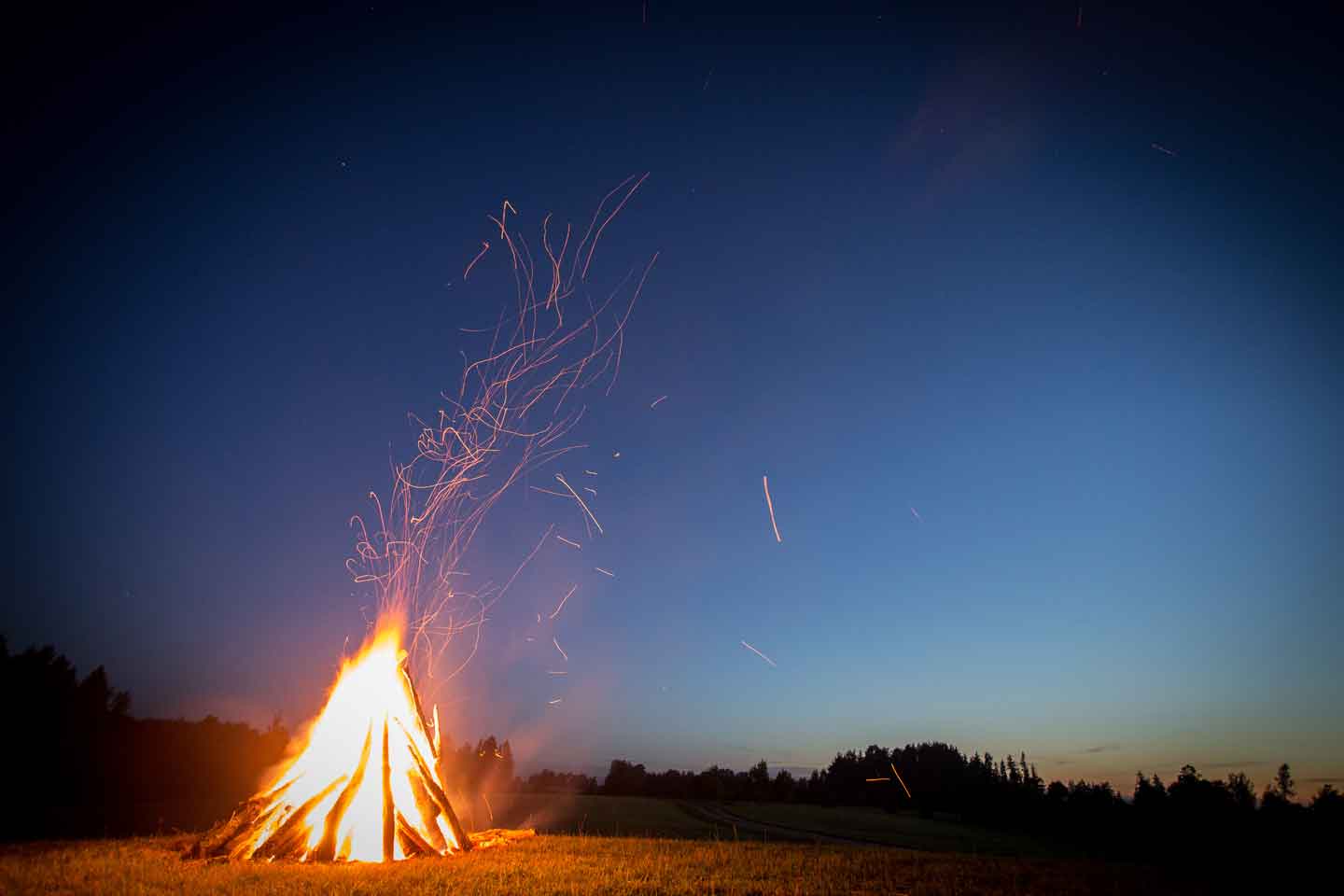
Bonfires everywhere. Perhaps the most iconic Lag BaOmer tradition, bonfires light up Jewish communities around the world. The fire symbolizes the spiritual light and wisdom of Rabbi Shimon bar Yochai. In Israel, you’ll see bonfires in parks, backyards, and open fields from the night before. Kids drag wood scraps into piles for weeks in advance. It smells like camp, basically.
Lag BaOmer Celebrations
If you want to see Lag BaOmer at its most intense, look no further than Meron, a mountain in northern Israel where Rabbi Shimon bar Yochai is buried. Every year, hundreds of thousands of Jewish people, many of them Hasidic, make a pilgrimage there. It’s one of the largest annual gatherings in Israel. There’s singing, dancing, and the lighting of enormous bonfires at the tomb. It’s completely overwhelming in the best way possible.
But you don’t have to go to Israel to feel the energy of the day. Israeli and Jewish communities in cities like New York mark Lag BaOmer with outdoor gatherings, barbecues, and bonfires in parks and backyards. Chabad centers around the world host community bonfires that are open to everyone, no background or synagogue membership required.
Archery is also a Lag BaOmer tradition, particularly popular with kids. The origins are debated, but one explanation is that it connects to the rebellion of Bar Kokhba, a Jewish military leader who fought against Roman rule in the second century, around the same time as Rabbi Akiva. Another explanation is more symbolic: the rainbow (shaped like a bow) did not appear during Rabbi Shimon bar Yochai’s lifetime because his merit was great enough to protect the world on its own. Either way, kids love it, and it’s a good excuse to go outside.
Lag BaOmer Songs
Music is central to how Lag BaOmer gets celebrated, especially in Hasidic tradition where the day is considered deeply joyful and spiritually significant. Bonfires almost always come with singing, and many of the songs are in Hebrew and Yiddish, drawing on kabbalistic themes about light, fire, and the teachings of Rabbi Shimon.
You don’t need to know a single word of Hebrew to participate. At a community bonfire, just follow the melody. At a Chabad gathering, someone will almost certainly be playing guitar. It’s that kind of night.
Some popular Lag BaOmer songs draw directly from the language and imagery of the Zohar. Others are more festive and less mystical. One of the best-known is “Bar Yochai,” a Hebrew poem written in the 16th century in honor of Rabbi Shimon. It’s been set to dozens of melodies over the years and is something of an unofficial anthem of the holiday.
If you want a Lag BaOmer playlist to get in the spirit, search “Lag BaOmer songs” on YouTube or Spotify and you’ll find everything from traditional niggunim (wordless melodies) to full Hasidic choir arrangements. Some of them are really catchy!
Make It Your Own
You don’t have to be observant to celebrate Lag BaOmer. Light a bonfire. Have people over for a BBQ. Take your kiddo for their first haircut. Put on music and dance. Tell people there’s a Jewish holiday happening and you’re celebrating it. That counts! It’s all about connection and joy, wherever you happen to be on your Jewish journey!
Frequently Asked Questions
When is Lag BaOmer 2026? Lag BaOmer 2026 begins at sundown on May 4 and continues through May 5.
What does “Lag BaOmer” mean in Hebrew? “Lag” comes from the Hebrew letters lamed and gimel, which together have a numerical value of 33. “BaOmer” means “of the Omer.” So: the 33rd day of the Omer. The name is also sometimes spelled Lag B’Omer.
What is the Omer? The Omer (meaning “sheaf” in Hebrew) refers to both a grain offering brought to the Temple in ancient times and the 49-day counting period between Passover (Pesach) and Shavuot. Each night, Jewish tradition calls for counting one day of the Omer. Lag BaOmer falls in the month of Iyar, roughly five weeks into the count.
Why is Lag BaOmer a day of joy if it’s also a yahrzeit? In Jewish tradition, the yahrzeit of a great sage isn’t always solemn. Rabbi Shimon bar Yochai specifically requested that his death anniversary be celebrated, because he spent his final hours revealing the deepest teachings of Jewish mysticism. In kabbalistic tradition, that makes it a day of spiritual light rather than grief.
What is the Zohar? The Zohar is the central text of Kabbalah, the mystical dimension of Judaism. It’s written primarily in Aramaic and offers a deeply symbolic interpretation of the Torah. It’s traditionally attributed to Rabbi Shimon bar Yochai, though scholars debate its origins. Either way, it’s dense, fascinating, and not exactly beach reading.
What is upsherin? Upsherin is the traditional first haircut given to boys when they turn three years old, often celebrated on or around Lag BaOmer. It’s observed mainly in Hasidic and other traditional Jewish communities. The ceremony marks a transition in the child’s Jewish education and is often a family gathering.
Do I need to do anything special for Lag BaOmer? Nope. Unlike Passover or Shabbat, there are no required rituals. Light a bonfire if you can, enjoy some time outside, and consider it a good excuse to gather with people you like.
What is Chabad’s connection to Lag BaOmer? Chabad, a major Hasidic movement, places enormous emphasis on Lag BaOmer because of its kabbalistic roots and connection to Rabbi Shimon bar Yochai. Chabad centers worldwide host community bonfires and events on Lag BaOmer, and they’re open to anyone. You do not have to be affiliated or religious to show up.
Want more Jewish holidays, traditions, and zero JewBarrassment? Sign up for the JewBelong newsletter and we’ll bring it all straight to your inbox.