
Most Rosh Hashanah traditions happen around a dinner table or inside a synagogue. Tashlich happens outdoors, beside a river, lake, pond, or other natural body of water, with a handful of bread crumbs and a lot of quiet reflection. It’s one of the most meaningful and accessible traditions of the Jewish New Year.
In short: Tashlich is a Jewish Rosh Hashanah ritual in which people symbolically cast bread crumbs into flowing or natural water to represent letting go of the previous year’s mistakes and beginning the Jewish New Year with reflection, renewal, and hope.
Observed during the High Holidays, Tashlich (pronounced tash-LIKH) invites people to pause, reflect on the past year, and physically act out the process of letting go. Whether you join a community gathering or quietly visit the water on your own, the ritual offers a simple, memorable way to enter the new year with intention.
What Is Tashlich?
The name Tashlich comes from the Hebrew word v’tashlich (“You will cast”) in Micah 7:19: “You will cast all their sins into the depths of the sea.” The ritual takes both its name and its central image from that verse. During the ceremony, Jewish people visit a natural body of water, recite prayers and readings, and toss bread crumbs into the water as a symbol of releasing the sins, regrets, and missteps of the past year. The crumbs drift away, reminding us that reflection is meant to lead somewhere: toward growth, forgiveness, and a fresh start.
The ceremony can take place as part of a synagogue service, at a community gathering, or quietly with family, friends, or on your own. There isn’t one “right” way to observe Tashlich, which is part of what has helped the tradition endure for centuries.
What Does Tashlich Mean?
The heart of Tashlich comes from the Book of Micah, one of the books of the Hebrew Bible and the Prophets. The key verses, Micah 7:18-20, describe a God who pardons iniquities and casts the sins of the people into the depths of the sea. That powerful image of sins being cast into deep water is where the Tashlich tradition gets both its name and its central metaphor.
Tashlich is woven into the larger framework of teshuvah, the Hebrew word often translated as repentance, return, or turning back. Teshuvah is one of the central themes of the High Holidays, the Jewish New Year, and the Days of Awe. It teaches that Rosh Hashanah isn’t just a celebration. It’s an invitation to take stock of your life, make amends, seek forgiveness, and return to your best self. Tashlich gives that deeply personal process a physical expression.
Why Do Jewish People Perform Tashlich?
Tashlich reminds us that Judaism believes people can change. The ritual isn’t about pretending the past never happened. It’s about acknowledging mistakes, taking responsibility, asking forgiveness where possible, and choosing to move forward with intention. Throwing bread crumbs into the water doesn’t magically erase sins. Instead, it gives physical form to the inner work of reflection, repentance, forgiveness, and renewal that defines the High Holidays.
There’s also a beautiful connection to the Binding of Isaac, the Torah story traditionally read on Rosh Hashanah. According to one Midrash, when Abraham and Isaac traveled to Mount Moriah, Satan tried to stop them by creating a deep body of water in their path. They walked through it anyway. The water in Tashlich carries an echo of that story: obstacles, faith, perseverance, and moving forward.
Where Did the Tashlich Tradition Come From?
The exact origins of Tashlich as a formal Jewish ritual aren’t spelled out in the Talmud. Instead, the custom developed gradually, becoming widespread in Ashkenazi Jewish communities during the medieval period before spreading to Sephardic and many other Jewish communities around the world. Like many beloved Jewish traditions, Tashlich evolved over time while remaining rooted in ancient Jewish ideas about repentance, forgiveness, renewal, and beginning the Jewish New Year with intention.
When Is Tashlich?
Tashlich is traditionally observed on the afternoon of the first day of Rosh Hashanah, often after the midday meal. If the first day of Rosh Hashanah falls on Shabbat, many Jewish communities observe Tashlich on the second day instead, since carrying items like bread crumbs in public is avoided on Shabbat. If neither day is possible, Tashlich can also be observed later during the Ten Days of Repentance before Yom Kippur.
Where Do You Do Tashlich?
Tashlich is traditionally observed at a body of water, such as a river, lake, stream, pond, or ocean. Flowing water is often preferred, and many Jewish communities choose a place with fish, since fish symbolize watchfulness in Jewish tradition (they don’t have eyelids). But don’t stress too much about the fish situation. The spirit of the practice matters far more than checking every box.
Many synagogues organize communal Tashlich ceremonies, which can be a lovely way to observe the tradition alongside other Jewish people. But if that’s not accessible or appealing, doing Tashlich on your own or with family is completely appropriate.
How Do You Do Tashlich?
Tashlich is simple: go to a body of water on Rosh Hashanah, spend a few minutes reflecting on the past year, say a prayer or meaningful reading, and symbolically cast away what you hope to leave behind.
How to Do Tashlich in Four Simple Steps
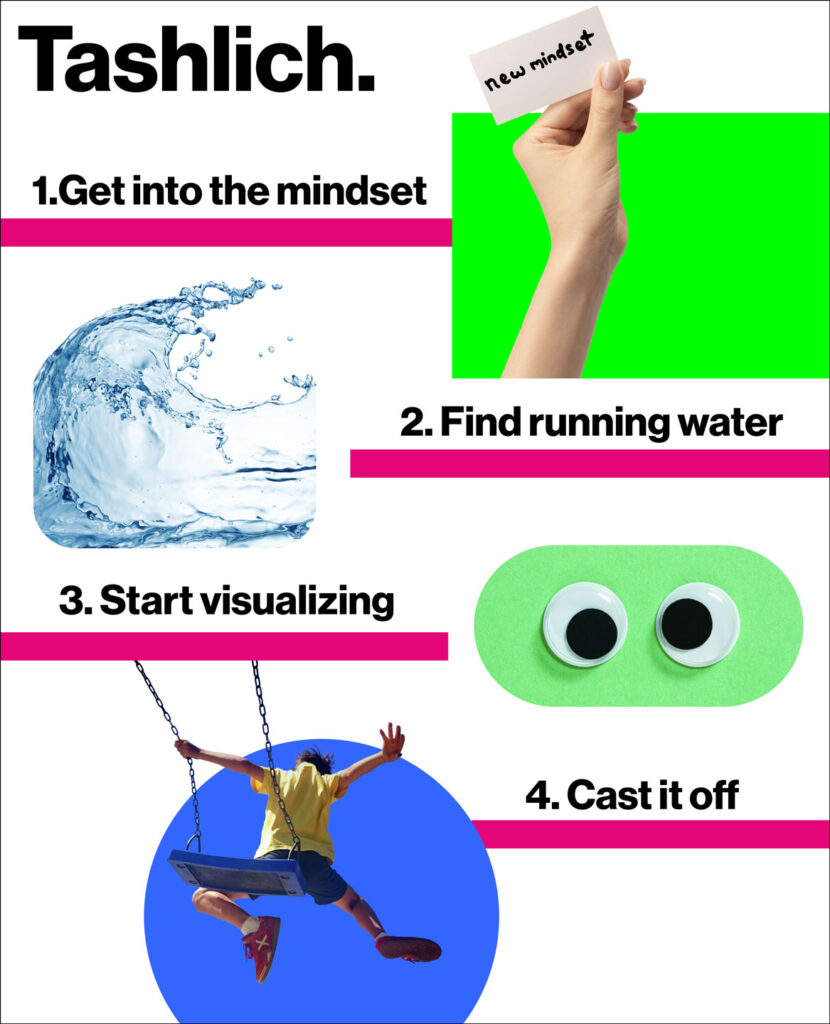
1. Get into the mindset: Start with the readings on page 19 of JewBelong’s free High Holidays booklet. They’ll help you get into the right mindset to think about what you need to let go of (guilt, habits, shame, etc.) Essentially whatever you need to release to start your year with a clean slate. You know the stuff we mean.
2. Find running water: A creek or river is ideal, but any body of water will do. If that’s truly impossible, the intention matters more than the location.
3. Start visualizing: Take a deep breath and visualize whatever weighs you down floating away. Don’t rush this part. If you’d like words to accompany the ritual, Rabbi Rachel Barenblat offers this beautiful prayer:
Here I am again ready to let go of my mistakes. Help me to release myself from all the ways I’ve missed the mark. As I cast this bread upon the waters, lift my troubles off my shoulders. Help me to know that last year is over, washed away like crumbs in the current. Open my heart to blessing and gratitude.
Renew my soul as the dew renews the grasses. Amen.
4. Cast it off: Then, whoosh, cast it away! It’s best to use breadcrumbs as a stand-in so you are actually tossing something.
Take another deep breath. You’ve earned it!
That’s it. There’s no single correct way to observe Tashlich. Some people read the traditional Tashlich prayers. Some bring poetry or personal readings. Some stand quietly. Some cry a little (no judgment). The point is the intention, not the performance.
If you’re doing Tashlich with kids, it can be a surprisingly rich conversation starter. What do we want to leave behind this year? What kind of people do we want to be? Kids often connect with this kind of concrete ritual more than adults expect.
What Prayer Is Said During Tashlich?
The traditional Tashlich prayers draw primarily from the Book of Micah, especially Micah 7:18–20, along with selections from Psalms. Many Jewish communities also include personal prayers and readings about forgiveness, reflection, and renewal.
Traditional Tashlich Prayers
The traditional Tashlich prayers draw from the Book of Micah and a selection of Psalms.
Micah 7:18–20
These verses from the Book of Micah are the heart of the Tashlich ceremony and have inspired Jewish communities for centuries. They ask a simple but stunning question: What kind of God forgives like this? A God who doesn’t hold grudges. A God who delights in kindness. A God who takes the worst of what we’ve done and casts it into the depths of the sea. Reading these words beside the water, with bread crumbs in hand, feels very different from reading them on a page.
Traditional translation:
“Who is a God like You, who pardons iniquity and passes over the rebellious act of the remnant of His possession? He does not retain His anger forever, because He delights in unchanging love. He will again have compassion on us; He will tread our iniquities under foot. Yes, You will cast all their sins into the depths of the sea. You will give truth to Jacob and unchanging love to Abraham, which You swore to our forefathers from the days of old.”
Psalms Traditionally Read During Tashlich
Several Psalms are commonly included in Tashlich, particularly Psalm 118 and Psalm 130. Psalm 130 is especially beloved during Tashlich because it begins in despair and ends in hope.
Out of the depths I call to You. Please hear me. If You kept a record of every wrong thing I’ve ever done, none of us would stand a chance. But You forgive. That’s why we come to You. I wait for You, more than someone waiting for morning. Because with You there is kindness, and the power to begin again.
That’s the spirit of Tashlich in a few short sentences.
A Modern Reading: “Forgive, Forgive, Forgive”
This reading appears in JewBelong’s High Holidays booklet and has resonated with many people who find traditional liturgy difficult to access. It’s by an unknown author, and it’s pretty much perfect for standing at the water’s edge.
If I have harmed anyone in any way, either knowingly or unknowingly, through my own confusions, I ask their forgiveness. If anyone has harmed me in any way, either knowingly or unknowingly, through their own confusions, I forgive them. And if there is a situation I am not yet ready to forgive, I forgive myself for that. For all the ways that I harm myself, negate myself, doubt myself, belittle myself, judge myself, or am unkind to myself through my own confusions, I forgive myself.
Simple. Honest. No Hebrew required.
For more readings like this one, download JewBelong’s free High Holidays booklet. There’s a lot of good stuff in there.
Can You Make Tashlich Your Own?
Absolutely.
Tashlich has been observed in Jewish communities for centuries, but it has never been a one-size-fits-all tradition. Ashkenazi Jewish communities (with roots in Eastern Europe) helped popularize the practice and tend to follow a fairly consistent set of prayers. Sephardic Jewish communities (with roots in Spain, North Africa, and the Middle East) have their own beautiful variations, including different readings and customs around when and how the ceremony is observed.
And then there are the people who show up at the water with bread crumbs and no real script, doing their best. Those people are doing Tashlich too.
If you’re part of an interfaith family, if you haven’t celebrated the High Holidays in years, or if you’re not sure what you believe but you’re drawn to the ritual anyway, welcome. Tashlich is one of those Jewish traditions that works on multiple levels. Even as a purely human practice, standing beside water and physically releasing something from the past year can be deeply meaningful. Judaism gives the ritual its depth, but the act itself is something almost anyone can appreciate.
You don’t need a rabbi. You don’t need a minyan. You don’t need to know how to pronounce teshuvah (teh-SHOO-vah, for the record). You just need to show up.
Frequently Asked Questions About Tashlich
What if I don’t have access to a natural body of water?
The tradition calls for a natural body of water, ideally with fish, but the spirit of the practice matters more than perfect conditions. If you can get to a river, lake, pond, stream, or ocean, wonderful. If you can’t, do what you can. Some people have even used a fountain in a pinch.
Do you have to throw bread into the water during Tashlich?
Not necessarily. Bread crumbs are traditional, but many people use leaves, flower petals, or simply turn out their pockets as a symbolic gesture. The heart of Tashlich isn’t the bread. It’s the act of reflection, teshuvah, and choosing to begin the Jewish New Year with intention.
Is Tashlich mentioned in the Talmud?
Not directly. The Tashlich ceremony as we know it developed gradually and isn’t explicitly prescribed in the Talmud. Its roots are in the Book of Micah, and it became widespread during the medieval period, particularly in Ashkenazi Jewish communities. Some early rabbis were actually skeptical of the practice, but it stuck around anyway, which says something.
What’s the connection between Tashlich and Yom Kippur?
Tashlich is usually observed on the first afternoon of Rosh Hashanah. If someone can’t observe it then, many communities perform it later during the Ten Days of Repentance, before Yom Kippur. While Yom Kippur concludes the process of teshuvah, Tashlich marks its beginning.
What comes after the High Holidays?
After Yom Kippur comes Sukkot, the joyful Jewish harvest festival. Many Jewish families celebrate by building and eating in a sukkah, an outdoor structure open to the sky. It’s a pretty fantastic shift in tone after the intensity of the Days of Awe.
Do all Jewish communities observe Tashlich the same way?
Not at all. Ashkenazi and Sephardic Jewish communities have different customs, prayers, melodies, and timing. Within those traditions, every synagogue and every family adds its own touches. That’s pretty standard for Judaism, which has always made room for variation, interpretation, and personal meaning.
Maybe that’s why Tashlich has endured for centuries. Judaism gives hope a ritual. Sometimes all we need is a little water, a little honesty, and the courage to begin again.
Download JewBelong’s free High Holidays booklet for more readings, prayers, and everything you need to navigate Rosh Hashanah, Yom Kippur, and the High Holidays without JewBarrassment.