If you’ve ever sat down at a Shabbat dinner and watched everyone around the table seem to know exactly what to do while you stared blankly at the candles… you’re not alone. Shabbat has a lot of moving parts. There are blessings over candles, wine, bread, and even hands. There’s a blessing for the kids. There’s a blessing to wrap the whole thing up at the end of Shabbat. It’s a lot.
But here’s the thing: none of this has to be intimidating. These blessings have been passed down for thousands of years precisely because they’re meaningful, not because they’re a test. You don’t need to be fluent in Hebrew, super religious, or a Shabbat expert to participate. You just need to show up.
We’ve put together this guide with every major Shabbat prayer and blessing, in Hebrew, transliteration (that’s the phonetic spelling so you can say it out loud), and English translation. Use what feels right for you, skip what doesn’t, and know that however you do it is just fine by us.
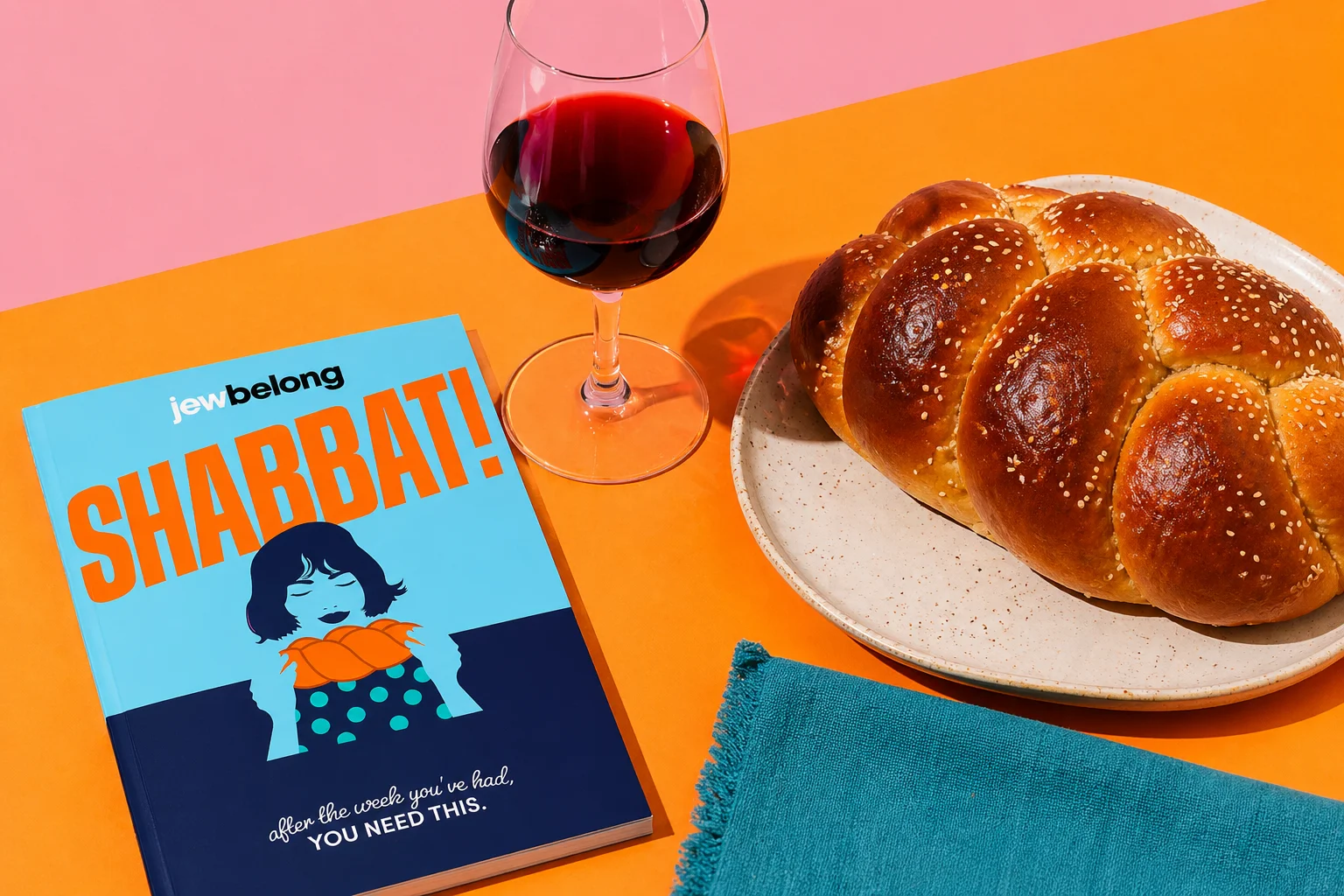
And if you want something you can print and bring to the table, our free Shabbat booklet has you covered. Pretty fantastic, and did we mention it’s free?
Friday Night (Erev Shabbat) Blessings
Friday night is the heart of Shabbat. As the sun goes down, the week officially ends and something quieter, more intentional begins. The blessings below follow the traditional order of a Friday night Shabbat dinner. Do all of them, do a few, or just read along. No wrong answers here.
Blessing Over the Candles – Hadlakat Nerot
This is where Shabbat officially begins. Traditionally, the Shabbat candles are lit by the woman of the household, but today anyone can light them. (And yes, if you’re a household of one, you light them yourself. Go you.)
The ritual goes like this: light the candles, wave your hands over the flames in a welcoming gesture, cover your eyes, and recite the blessing. When you open your eyes, Shabbat has arrived.
Hebrew:
בָּרוּךְ אַתָּה יְיָ אֱלֹהֵינוּ מֶלֶךְ הָעוֹלָם, אֲשֶׁר קִדְּשָׁנוּ בְּמִצְוֹתָיו וְצִוָּנוּ לְהַדְלִיק נֵר שֶׁל שַׁבָּת.
Transliteration:
Baruch Atah Adonai, Eloheinu Melech Ha-olam, asher kid’shanu b’mitzvotav v’tzivanu lihadlik ner shel Shabbat. Amen.
English:
We praise God, Spirit of Everything, who has made us holy with your mitzvot and commanded us to light the Shabbat lights. Amen.
After the blessing, many people take a quiet moment with eyes still covered to say a personal prayer or just… breathe. It’s one of the most peaceful moments of the week. TBH, that part alone might be worth it.
Blessing for the Children – Birkat Habanim
Right after candle lighting, many families pause to bless their children. Parents place their hands gently on each child’s head and offer a blessing. It’s one of the most tender moments of the whole evening.
There are traditional blessings for sons and daughters, though plenty of families use one version for everyone or add their own words.
For sons:
Transliteration:
Y’simcha Elohim k’Efraim v’chi-Menashe.
English:
May God make you like Ephraim and Manasseh.
For daughters:
Transliteration:
Y’simeich Elohim k’Sarah, Rivkah, Rachel v’Leah.
English:
May God make you like Sarah, Rebecca, Rachel, and Leah.
Both are followed by:
Transliteration:
Y’varech’cha Adonai v’yishm’recha. Ya’er Adonai panav eilecha vichuneka. Yisa Adonai panav eilecha v’yasem l’cha shalom.
English:
May God bless you and protect you. May God’s presence shine on you and be good to you. May God reach out to you tenderly and give you peace.
No kids at the table? Some couples bless each other. Some people bless themselves. Some skip it entirely. All good.
The Blessing Over Wine (or Grape Juice) – Kiddush
Kiddush means “sanctification,” and it’s the blessing that formally declares Shabbat holy. It’s recited over a full cup of wine or grape juice. (Grape juice is completely legitimate. We promise. No JewBarrassment.)
The Friday night Kiddush is longer than the Saturday morning version and references both the creation of the world and the Exodus from Egypt. It’s a lot of history in one little cup of wine.
Transliteration:
Vayehi erev vayehi voker, yom hashishi.
Vayechulu hashamayim v’ha’aretz v’chol tzeva’am.
Vayechal Elohim bayom hashvi’i melachto asher asah,
vayishbot bayom hashvi’i mikol melachto asher asah.
Vayevarech Elohim et yom hashvi’i vayekadesh oto,
ki vo shavat mikol melachto asher bara Elohim la’asot.
Baruch Atah Adonai, Eloheinu Melech ha-olam,
borei p’ri hagafen. Amen.
Baruch Atah Adonai, Eloheinu Melech ha-olam,
Asher kid’shanu b’mitzvotav v’ratzah vanu,
V’Shabbat kodsho, b’ahavah uv’ratzon hinchilanu,
Zikaron l’ma’aseh v’reishit.
Ki hu yom t’chilah, l’mikra’ei kodesh,
Zecher litziat Mitzrayim.
Ki vanu vacharta v’otanu kidashta mikol ha’amim,
V’Shabbat kodshecha b’ahavah uv’ratzon hinchaltanu.
Baruch Atah Adonai, m’kadeish HaShabbat. Amen.
English:
And there was evening and there was morning, the sixth day.
The heavens and the earth were finished.
And on the seventh day, God ended all the work and rested.
And God blessed the seventh day.
We praise God, Spirit of Everything, creator of the fruit of the vine. Amen.
Blessed are You, who sanctifies us with commandments and has been pleased with us. You have lovingly and willingly given us Your holy Shabbat as an inheritance in memory of creation. The Shabbat is the first among our holy days and a remembrance of our exodus from Egypt. Indeed, You have chosen us and lovingly given us Your holy Shabbat as an inheritance. Blessed are You, who sanctifies the Shabbat. Amen.
After Kiddush, everyone drinks from the cup. L’chaim!
Hand Washing Blessing – Netilat Yadayim
Before eating the bread, there’s a quick hand-washing ritual called Netilat Yadayim (neh-tee-LAHT yah-DAH-yeem). You pour water over each hand using a cup, recite the blessing, and then stay quiet until after the bread blessing. (Yes, really. It’s a short silence, not a vow of silence. You’re fine.)
Transliteration:
Baruch Atah Adonai, Eloheinu Melech ha-olam, asher kid’shanu b’mitzvotav v’tzivanu al n’tilat yadayim.
English:
We praise God, Spirit of Everything, who has sanctified us with Your commandments and commanded us concerning the washing of hands.
The idea behind this ritual is about intention and mindfulness, not hygiene. It’s a way of saying: we’re about to do something meaningful. Let’s show up for it.
Blessing Over the Challah – Hamotzi
Here comes the bread. At a Shabbat table, there are traditionally two loaves of challah (that beautiful braided egg bread), which represent the double portion of manna that fell for the Israelites in the desert every Friday so they wouldn’t have to gather food on Shabbat. Pretty thoughtful, right?
Uncover the challah, lift the loaves (or just one if that’s what you’ve got), say the blessing, tear or slice a piece, salt it, and pass it around.
Transliteration:
Baruch Atah Adonai Eloheinu Melech Ha-olam ha’motzi lechem min ha’aretz. Amen.
English:
Blessed are you, Lord our God, Spirit of the Universe, who brings forth bread from the earth. Amen.
Don’t have challah? Any bread works. Don’t have two loaves? One is fine. Don’t have bread at all? Well… maybe order some pizza. (We’re not here to judge.)
Blessings After the Meal — Birkat Hamazon
Birkat Hamazon (beer-KAHT hah-mah-ZONE) is the blessing recited after eating a meal that included bread. Traditionally, it can begin with a psalm on Shabbat (Psalm 126, Shir Hama’alot) to set the tone—but we don’t include that here, so you can jump right into the blessing itself.
There’s a short version and a long version. Both are completely valid. Most families choose based on how full they are and how much energy is left in the room.
The version below is a streamlined take on Birkat Hamazon. It includes the traditional opening blessing—thanking God for providing food for the world—followed by an English reflection that captures the core themes of the full prayer: gratitude, sustenance, and a hope for peace.
Transliteration:
Baruch Atah Adonai, Eloheinu Melech ha-olam
hazan et ha’olam kulo b’tuvo b’chen b’chesed v’rachamin.
Hu noten lechem l’chol basar ki l’olam chasdo.
Uv’tuvo hagadol tamid lo chasar lanu v’al yech’sar lanu mazon l’olam va’ed.
Ba’avur sh’mo hagadol ki hu zan um’farnes lakol umetiv lakol
umechin mazon l’chol b’riyotav asher bara.
Baruch Atah Adonai hazan et hakol.
English:
We praise God, Spirit of Everything.
You are the origin of love and compassion, the source of bread for all.
We praise God, source of food for everyone.
As it says in the Torah: When you have eaten and are satisfied, give praise to God who has given you this good earth.
We praise God for the earth and for its sustenance.
Renew our spiritual center in our time.
May the source of peace grant peace to us, to the Jewish people, and to the entire world.
Saturday Morning — Shabbat Morning Kiddush
Shabbat doesn’t end Friday night. Saturday is still Shabbat, and there’s a morning Kiddush too, recited before the daytime meal. It’s shorter than the Friday night version, which is a relief for everyone who’s a little more tired on Saturday morning.
Transliteration:
Al kein beirach Adonai et yom haShabbat vay’kad’sheihu.
Baruch Atah Adonai, Eloheinu Melech ha-olam, borei p’ri hagafen.
English:
Therefore God blessed the Shabbat day and sanctified it.
We praise God, Spirit of Everything, who creates the fruit of the vine.
Same idea, shorter blessing, same delicious wine (or grape juice).
Blessings to End Shabbat — Havdalah
Havdalah (hav-DAH-lah) means “separation,” and it’s the ceremony that closes Shabbat on Saturday night, once three stars appear in the sky. It marks the transition back to the regular week with four distinct blessings: one over wine, one over spices, one over a braided candle, and one final blessing of separation.
The spices are there so you can carry a little sweetness with you into the week. The braided candle is lit and then extinguished in the wine at the end. It’s bittersweet in the best way.
Blessing over wine:
Transliteration:
Baruch Atah Adonai, Eloheinu Melech ha-olam, borei p’ri hagafen.
English:
We praise God, Spirit of Everything, who creates the fruit of the vine.
Blessing over spices:
Transliteration:
Baruch Atah Adonai, Eloheinu Melech ha-olam, borei minei v’samim.
English:
We praise God, Spirit of Everything, who creates varieties of spices.
Blessing over the candle:
Transliteration:
Baruch Atah Adonai, Eloheinu Melech ha-olam, borei m’orei ha’eish.
English:
We praise God, Spirit of Everything, who creates the lights of fire.
Blessing of separation:
Transliteration:
Baruch Atah Adonai, Eloheinu Melech ha-olam, hamavdil bein kodesh l’chol, bein or l’choshech, bein Yisrael la’amim, bein yom hash’vi’i l’sheishet y’mei hama’aseh. Baruch Atah Adonai, hamavdil bein kodesh l’chol.
English:
We praise God, Spirit of Everything, who distinguishes between the sacred and the ordinary, between light and darkness, between Israel and the other peoples, between the seventh day and the six days of work. Blessed are You, Eternal, who distinguishes between the sacred and the ordinary.
After Havdalah, Shabbat is officially over. Many people wish each other “Shavua tov” (sha-VOO-ah tov), which means “a good week.” It’s a lovely way to walk back into the world.
You Don’t Have to Do All of This
Seriously. Light the candles. Say one blessing. Pour the wine and eat some challah. Even just gathering around a table and being present counts. Shabbat has been practiced in all kinds of ways for thousands of years, and it’ll be just fine with however you show up to it.
Our free Shabbat booklet includes the blessings most people actually use at the Shabbat table, including wine, challah, and other accessible, easy-to-follow prayers in Hebrew, transliteration, and English. It’s not every single Shabbat blessing ever written, because that would be less “helpful guide” and more “please cancel your plans.” It’s the usable version, and it’s completely free.