Archie Gottesman used to advertise the glories of Judaism to lapsed New York Jews. But in the post-October 7 era, she has a new mission.
By Ben Kawaller
The Times | August 28, 2026
Archie Gottesman misses the days when her biggest headache was the Jews. The founder of JewBelong, a non-profit that seeks to cultivate Jewish identity amongst the non-observant, was once chided for erecting a billboard in Seattle that read “Judaism: Come for your girlfriend, stay for the lack of Hell”.
“There was a rabbi who called me up,” Gottesman told me in her West Village home office. “She’s like… ‘I think it might be causing antisemitism.’”
Gottesman pushed back. How exactly was her billboard doing that? The rabbi said: “I’ll call you back. I have to go try to find the other rabbis.” When she got back to her, she changed her tune. “OK, it’s not causing antisemitism,” she said, “but we don’t like it.”
Gottesman waved off the rabbis’ objections; they weren’t her target demographic, after all. At the time, JewBelong’s ads were aimed at lapsed Jews and converts. They promoted “tools to live your best Jew-ish life” — including booklets on how to run a proper Seder or Shabbat dinner to Jews so disengaged they “think kugel is an exercise for your vagina”.
After October 7, JewBelong’s Mission Changed
Gottesman’s kerfuffle with the Seattle rabbinate happened in August 2023. Only two months later, of course, everything would change. On October 7 Hamas invaded Israel, killing more than 1,200 people, including 378 at the Nova music festival, and taking more than 250 hostages. And JewBelong’s priorities shifted dramatically.
“We just wanted Jews to have a better Hanukkah,” Gottesman said about her original mission. “I now spend most of my time dealing with antisemitism.”
With anti-Jewish and anti-Israel sentiment on the rise in the US amid the war in Gaza, Gottesman is now less interested in reaching a Jewish audience; it’s allyship she’s looking for.
Although Jews only make up about 2 per cent of the US population, they were targeted in 14 per cent of all reported hate crimes (and 63 per cent of all religious ones) last year — seven times higher than the next religious group. These include the murder of two Israeli embassy staffers in Washington DC, and the firebombing of an event in Boulder, Colorado in support of the Israeli hostages.
In New York City, where Gottesman lives, Jews make up roughly a tenth of the population but are the victims in well over half of all hate crimes. Meanwhile support for Israel has plummeted among young Americans, whose attitudes towards the US ally range from apathy to fixated hostility.
In response to this five-alarm fire, Gottesman believes Jewish groups have failed to meet the moment. Legacy organisations, she says, convene panels and release statements to people who already agree with them. “Jews are wasting time talking to themselves,” she told me. “It is an echo chamber. It is a dangerous echo chamber.”
Taking the Message Beyond the Jewish Community
Instead, Gottesman buys ad space. She now spends about $4 million a year on billboards aimed at a different population: people who haven’t really given Jews much thought. Gottesman reports that the organisation saw a 42 per cent increase in donations in the 12 months after the October 7 attacks compared with the 12 months before.
The target audience is no longer lapsed Jews, it’s Gottesman’s fellow Americans: “The 98 per cent of the country who’s not Jewish.”
“The crux of it,” Gottesman told me, is not changing the minds of people already hostile to Jews or to Zionism. It’s “making people aware” that antisemitism is a problem, “because most people [are] not”. She likened her project to the Black Lives Matter campaign, which, she told me, raised her awareness of racial prejudice.
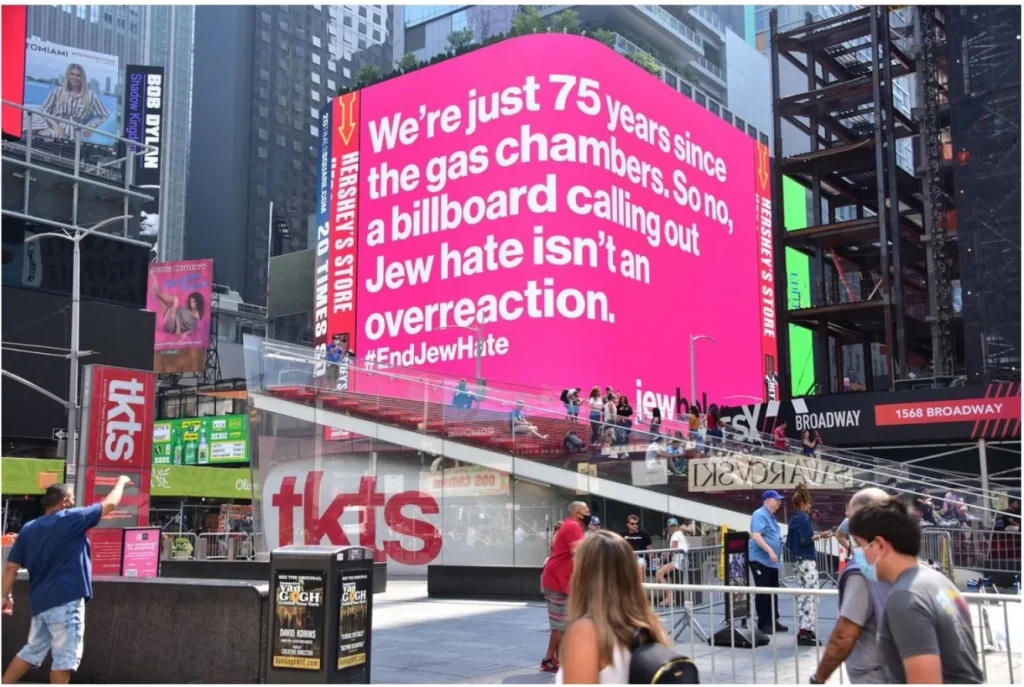
With a shift in mission has come a shift in tone. JewBelong has kept its lively, white-and-hot-pink colour palette, but the jokiness is gone. In its place is a perhaps grimmer humour.
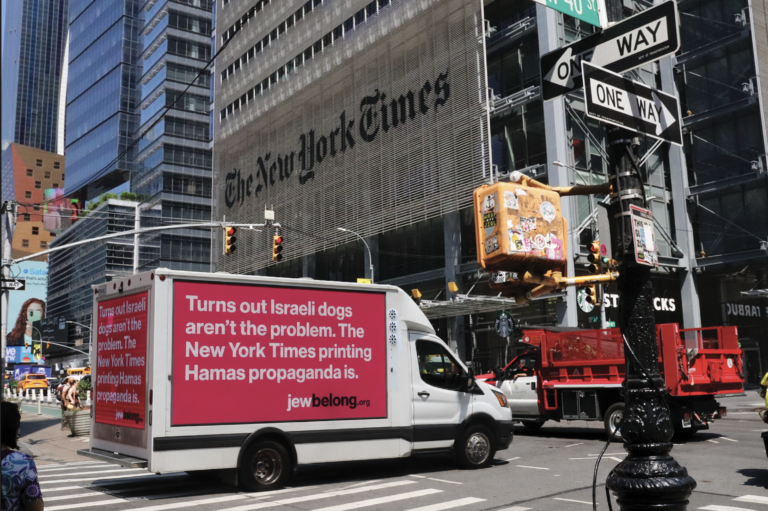
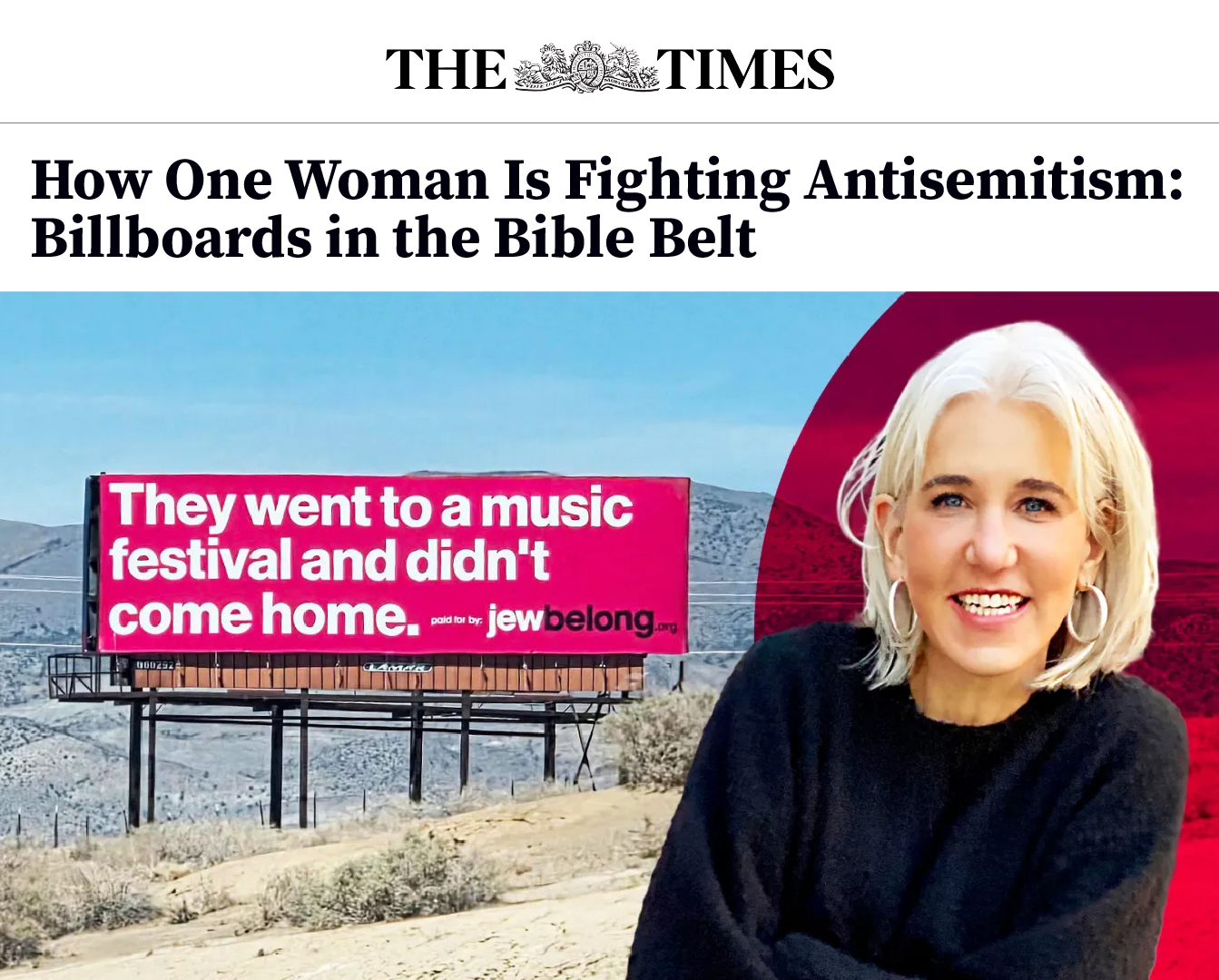
“Cultural Jews died in the gas chambers too. Speak up” reads one national campaign in the autumn of 2023. On the one-year anniversary of the attacks, JewBelong placed an ad on a Times Square billboard that blared: “See the sky? The hostages can’t.” This coming weekend, revellers bounding west for Burning Man on I-80 will see the message: “Imagine going to a music festival and not coming home.”
A Vanishing Constituency
Before founding JewBelong in 2017, Gottesman worked for Manhattan Mini Storage, the family business launched by her father and uncle, which sold for $3 billion in 2021.
Gottesman, who started at the firm in the 1980s, was the mastermind behind the cheeky branding that helped make it a New York City fixture. Back then, she said, “marketing was more like a woman’s job” and she discovered she had a knack for creating irreverent ad copy.
“Storage: Cheaper than therapy” was her first hit ad, kicking off a campaign that still produces funny, or at least funny-ish, billboards and posters, many of them with a decidedly anti-conservative slant. Around the 2008 election, one ad showed a torso of a woman meant to represent Sarah Palin and asked: “What’s more limited? Your closet or her experience?”
“I knew how to talk to New Yorkers,” Gottesman told me. “There was almost a safety in that.”
But that was a different time. Gottesman’s Manhattan Mini Storage portfolio reflects an era when New York was Jewier, when a Jewish New Yorker could be trusted to have the same politics as everyone else and where hostility to Israel wasn’t a leading cause of the progressive left.
The vibe shift was made clear after October 7 when college campuses exploded with an outpouring of support for Hamas. This has now morphed into an open hatred of “Zionism” — the belief that Israel should exist.
The election of New York City’s first anti-Zionist mayor, Zohran Mamdani, in November marks another deviation from the norm. Mamdani is, of course, a proud member of the Democratic Socialists of America, an anti-capitalist organisation for whom opposition to the existence of Israel is now a defining issue, much to the stupefaction of Gottesman.
“Why is that part of what they’re doing?” she would like to know, shaking her head at the obsession with Israel. “Why are they interested?” The answer, she says, is “obvious”: antisemitism.
And so, early on in Mamdani’s tenure, JewBelong attempted to erect billboards across the city that read: “Not gonna hide my Jewish star for a free bus ride.”
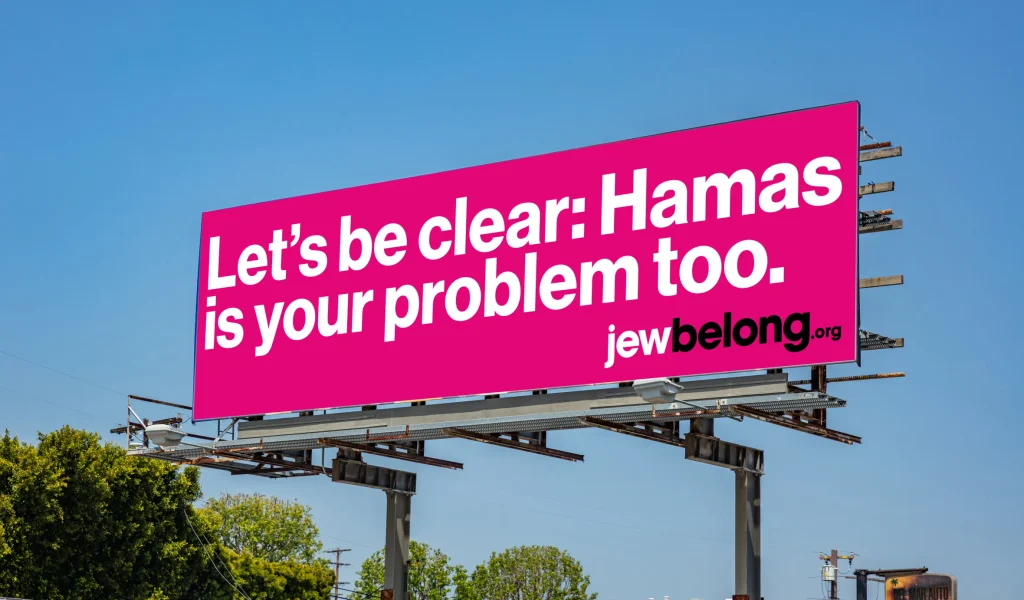
“The billboard companies wouldn’t take the message,” Gottesman told me. This was nothing new; she is used to having to find creative ways to get her point across. Most billboard companies, she also said, won’t allow the words “Israel”, “hostages”, “Gaza”, “terrorism”, “war”, “Hamas” and “protests”.
So in lieu of billboards, JewBelong put the message on about 800 taxi tops.
They didn’t stay there for long. A month into the campaign, the New York Post ran a story about the ads. The next day, Gottesman told me, the brokers who’d placed the ads told JewBelong they were being removed without saying exactly why.
“We never really got the full story,” she said with a shrug.
From Burning Man to the Bible Belt
Now, away from the urban centres that were once her challah and butter, Gottesman sees vast swathes of opportunity.
She calls her billboards “an awareness campaign”, adding that “they will never change someone who is negative to positive. But they will take someone who’s neutral and make them positive”.
“There are millions of people in the Bible Belt and Midwest area who are neutral about Israel, neutral about Jews,” she told me, “and that is where our focus should be.”
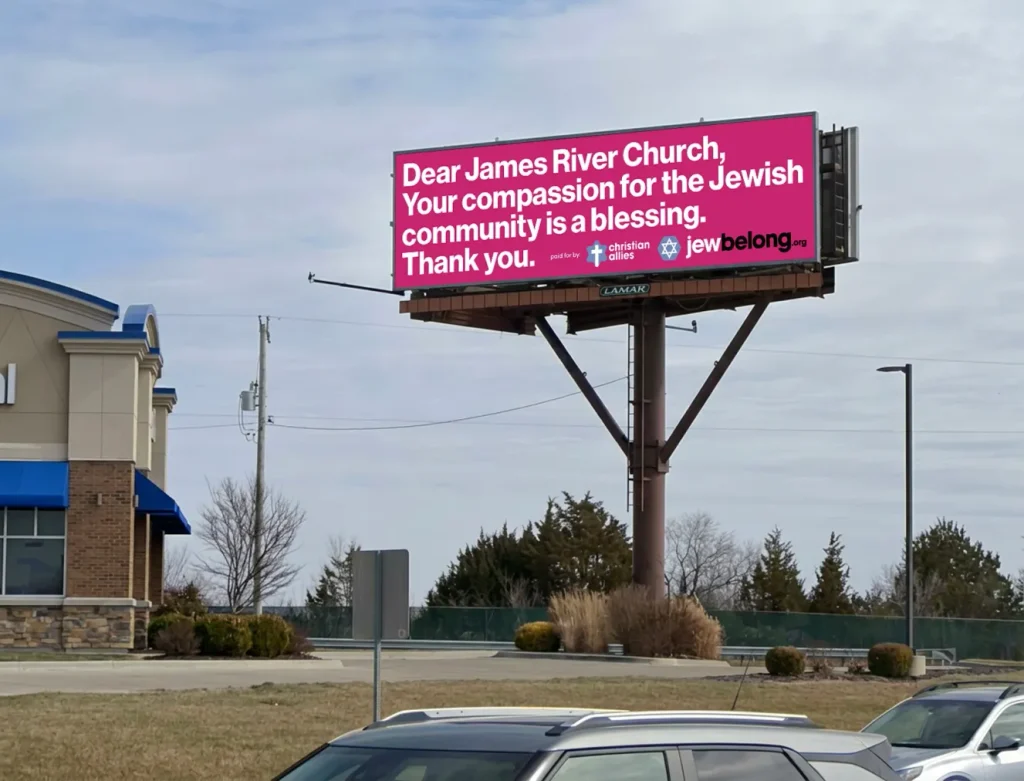
And so, this autumn, JewBelong is planning billboard campaigns in non-coastal cities such as Nashville in Tennessee, Dallas in Texas, Tulsa in Oklahoma, Waco in Texas, Little Rock in Arkansas and Lincoln in Nebraska, where Christian Americans will see messages such as “When Jesus said ‘Love Thy Neighbour,’ all his neighbours were Jews” and “An attack on one of us is an attack on all of us”.
This campaign is part of JewBelong’s partnership with a network of churches Gottesman has organised under the Christian Allies Collective.
To some onlookers, Christian conservatives seem like strange bedfellows for a New York Jew. Evangelical Zionism, after all, is rooted not in any particular identification with the Jewish people but in the belief that Jewish sovereignty in Israel is a prerequisite for the second coming of Christ.
But Gottesman has little patience for hand-wringing about what’s motivating her national network of churches. With Jews feeling increasingly isolated, the friendship of these new partners has left Gottesman palpably moved.
“They are being amazing,” she told me, before mentioning one minister in particular, Larry Huch of Tulsa. With an Oklahoma twang, she repeated his message to her: “I’ll never convert you, but I’ll never desert you.”
When she heard that, she says: “I was like, ‘Good enough for me.’”
Can Billboards Really Fight Antisemitism?
And yet, as lovely as that sentiment is, I couldn’t help wondering: can a billboard campaign really combat an ancient hatred?
JewBelong’s own research, which Gottesman shared with me, suggests that a three-month billboard campaign in Kansas City, Missouri may have led to greater awareness that Jewish Americans are feeling under threat. Personal testimonials reveal a general sympathy for Jews, as well as frequent surprise that “people were hating on Jews so badly”, as one respondent put it.
But JewBelong’s study, which claims to have found a 28 per cent increase in the number of people concerned about antisemitism, does not account for the effect of any outside influences, such as the Israeli embassy murders that took place in the three months the billboards were up. The study also did not include any respondents who identified as “not at all concerned” or “very concerned” about antisemitism.
Gottesman said this exclusion was an attempt to remove “everybody who has a strong feeling about Israel or Jews” so their research could focus on “the mushy middle”.
“If someone is Free Palestine–ing, it’s not gonna reach them,” she explained.
She points to the success of the “Stop Asian Hate” campaign, which was launched by the non-profit Stop AAPI Hate Action to respond to a rise in anti-Asian violence during Covid.
“I didn’t go home and read about Asian hate. I didn’t take a deep dive,” she said about her reaction to that campaign. “But it raised my awareness.”
Sourced from the original article.